
 Shawn Hall
 Few films have been as influential as The Cabinet of Dr. Caligari. Released in 1920, this early horror masterpiece didn’t just define a genre but also ushered in a golden age of German silent cinema and established visual techniques that later inspired the shadowy style of film noir. For that contribution to cinema, Dr. Caligari was voted #8 on Silent Era’s Top 100 Silent Movies List, which I’m reviewing as part of a bi-weekly series sharing whether I agree with each film’s inclusion on the list.
The film is told through the eyes of Francis, who recalls a strange time when a traveling showman named Dr. Caligari arrived in his town. Caligari’s carnival attraction is a somnambulist who predicts the future with eerie accuracy.
After predicting Francis’ friend will die later that night, the somnambulist is the one to make that prediction come true. Shortly after his friend’s death, Francis discovers his fiancée is kidnapped by the somnambulist and follows him back to Dr. Caligari, who has been controlling him to do his evil bidding. *SPOILERS AHEAD*

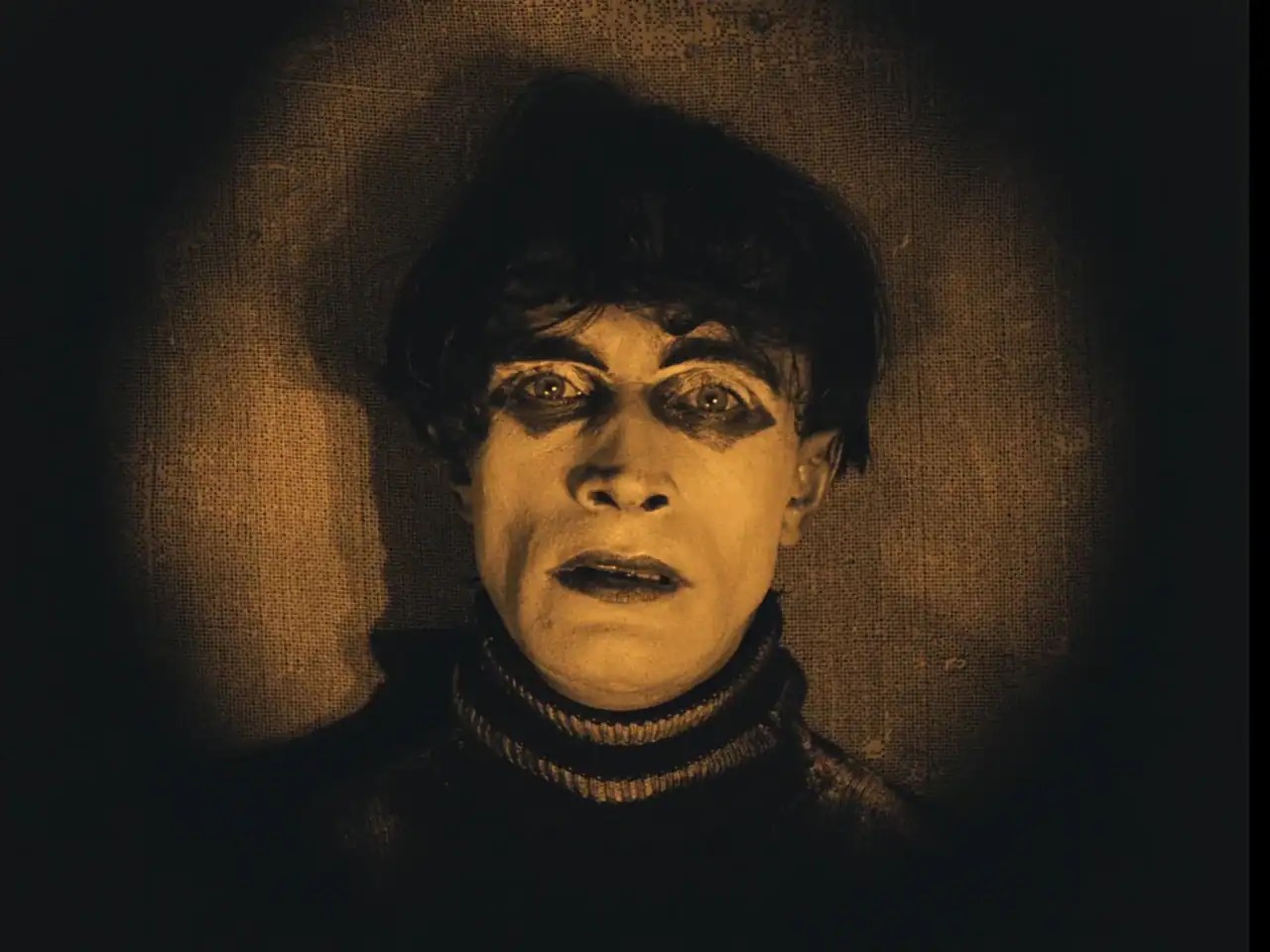
(Left) Francis tells his life story (Right) The Sommabulist at the fair
Francis discovers Dr. Caligari isn’t just a traveling showman but the doctor of a nearby insane asylum. When Francis ends his story, we discover that he himself is a patient in the same asylum. Everything we’ve just seen might have been imagined—a delusion born from his madness.
The “it was all in his head” twist has become cliché today; yet, the twist lands because the entire film already feels so removed from reality with its famous surreal and distorted set design. Nothing in the world looks quite right with houses with slanted roofs, chairs double the height of their occupants, and everyday objects twisting into geometrically impossible shapes. Even the lighting isn’t natural. Instead of using real lights, shadows, and highlights are painted directly onto the scenery.


Even the most mundane locations are turned into some expressive sets.
These artistic choices reflect the Expressionist movement, but they also set the stage for the story’s revelation. From the beginning, the audience is pulled into a world that looks like a dream slowly devolving into a nightmare. So when we learn that the story might be unfolding inside Francis’ mind, the visual cues have already prepared us for this outlandish reality.
Another key aspect of the twist is how the film ends. After the reveal, we don’t return to the “real” world. Instead, we stay in this eerie, off-kilter universe. Francis is strapped into a straitjacket, and the asylum doctor, who earlier appeared as the villain Dr. Caligari, announces a new treatment that will cure his troubled patient. The film closes in on Francis’ face as he shoots a menacing glare directly at us.
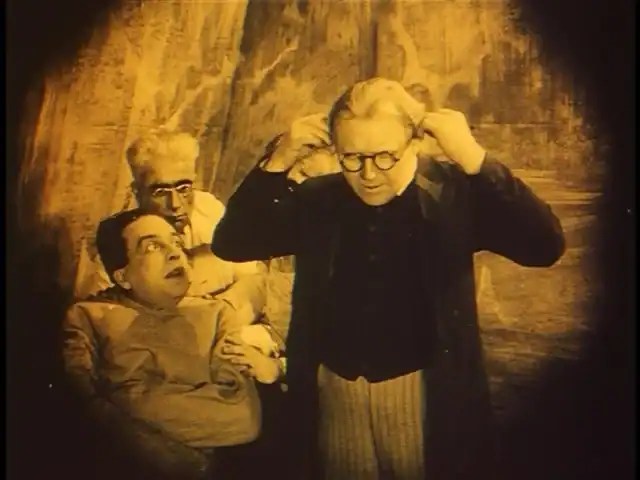

(Left) Dr. Caligari is about to ‘treat’ his patient (Right) The audience reacting to the film’s final twist
This final image leaves us deeply unsettled. Whether or not his delusions are true, Francis’ reality of being trapped in an institution with “treatments” that feel more sinister than healing in the early 20th century is just as terrifying as his twisted tale of the sommanabulist.
The Cabinet of Dr. Caligari is ranked number eight on Silent Era’s Top 100 Silent Movies list, and I completely agree with its high placement. It’s not only a visually inventive and influential film, but it also tells a disturbing story that still hits hard more than a century later, managing to be the rare film that pulls off its final “it was all just a dream” end.
Up next on the list, I’ll be covering E.A. Dupont’s 1925 German silent drama Variety, another German film that takes us in a very different direction than Dr. Caligari.


